
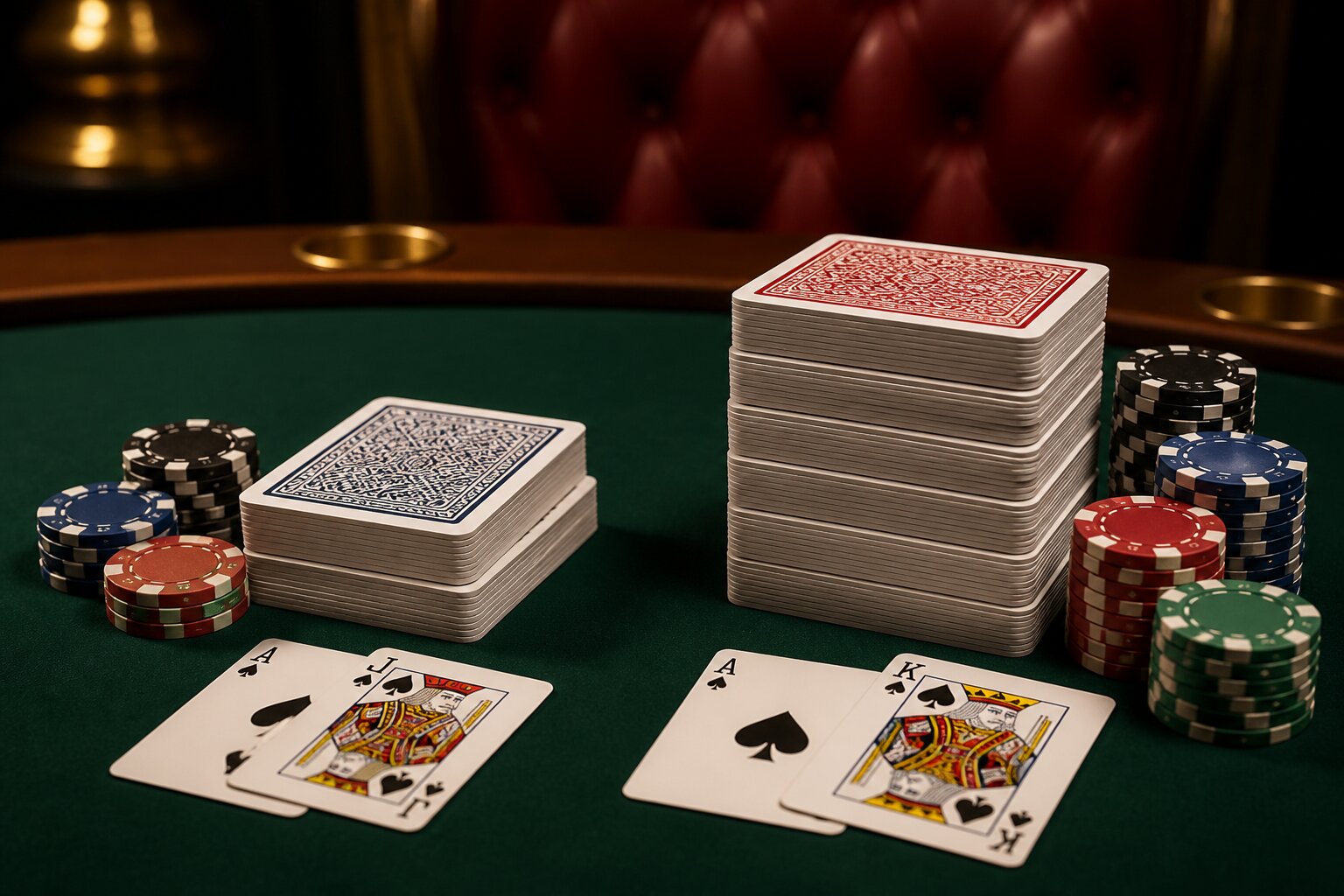
Deciding between a 2 deck or 6 deck blackjack table can affect the way you play and the small mathematical edges at work. The number of decks in use influences card distribution, shuffling patterns and sometimes the table rules you’ll encounter.
This guide explains those differences clearly, with examples and practical points to help you choose the format that suits your style of play. Read on to see how deck size interacts with house edge, rules and player choices so you can press on with confidence.
What Are the Main Differences Between 2 Deck and 6 Deck Blackjack?
The most obvious difference is the number of cards in play: two standard decks versus six. That change in scale alters how often specific cards appear and therefore affects the probabilities behind common outcomes, such as drawing a ten-value card or an Ace.
Smaller deck games tend to reach a reshuffle sooner and may be dealt from a hand shuffle or small shoe, while larger shoes are typically shuffled less often and can keep cards in play across more hands. Casinos often adjust other table rules when deck count changes, which is why two games with different deck counts can feel quite different even if the basic gameplay is the same.
Finally, the pace and flow of the table will differ. A 6 deck shoe often produces longer runs between shuffles, which some players find smoother, while 2 deck tables can feel more immediate and variable. Those differences influence not only the mathematics behind the game but also the atmosphere at the table.
How Does Deck Count Affect the House Edge in Blackjack?
The house edge is the long-term statistical advantage the game offers the casino. Deck count is one of the factors that nudges that percentage up or down. All else being equal, fewer decks tend to produce a slightly lower house edge because certain favourable card combinations become a bit more likely in a smaller pool.
For example, the frequency of natural blackjacks (an Ace and a ten-value card) is marginally higher in a two-deck game than in a six-deck shoe. Because casinos know this, they sometimes alter other rules to compensate, such as changing blackjack payouts or restricting doubling options, so the final house edge can end up similar across games.
It helps to think of the house edge as a cumulative number that reflects both deck count and specific table rules. If you want to compare games, look at the full rule set rather than deck count alone. That gives a clearer picture of the actual advantage the house holds over time.
Are the Rules for 2 Deck and 6 Deck Blackjack the Same?
The core rules of blackjack remain the same across both formats, but smaller differences often appear in how casinos implement them. Common variations include whether the dealer must hit or stand on a soft 17, the availability and terms for doubling down, and how many times or when players may split pairs.
Payouts for a natural blackjack are another key area. While a 3:2 payout is traditional, some tables with more decks may offer a lower payout. These rule tweaks are the primary way operators balance any mathematical advantage that might come from using fewer decks.
Because these rule differences matter to overall odds and strategy, it is sensible to review the table rules before you play so you understand how the game you’ve chosen will behave.
What Are the Odds of Winning in 2 Deck vs 6 Deck Blackjack?
Odds in blackjack are governed by the probabilities of card combinations given the current deck composition and table rules. With fewer decks, the chance of drawing certain hands shifts slightly because each card makes up a larger share of the cards remaining.
As an example, the chance of being dealt a blackjack is a little higher in a two-deck game than in a six-deck game. However, casinos may respond by changing payouts or rules, which can neutralise that advantage. That means the practical difference in winning odds between the two formats is often small once you account for the full rule set.
Remember that these probabilities describe long-term tendencies across many hands. Short-term outcomes will still vary from hand to hand. If you want to evaluate a specific table, compare the stated payouts and rules alongside the deck count to get a realistic sense of the odds you will face.
Does Deck Size Impact Payouts or Player Choices?
Deck size does not automatically change standard payouts, but operators sometimes offer different payout rates or rule options on multi-deck tables. For instance, lower blackjack payouts or restricted doubling can appear more often on larger shoe games to offset the statistical differences that deck count introduces.
Players respond to these subtle shifts by adapting their choices. In a smaller deck game, where the relative frequency of certain cards is altered, some players adjust when they hit, stand or split pairs. Those adjustments are tactical responses to changing probabilities rather than guaranteed improvements.
In practical terms, deck size is one of several variables that shape decision-making. The best approach is to assess the full rule package and then choose the table whose combination of rules, pace and stakes matches your preferences.
Myths About Multi-Deck vs Single-Deck Blackjack
There are a number of persistent ideas that oversimplify the comparison between single-deck and multi-deck games. One myth claims single-deck games are always superior for players. While reduced deck counts can offer a small mathematical advantage, operators balance that with rule changes and payouts, so a single factor does not determine the overall outcome.
Another misconception is that card counting reliably beats multi-deck games. Modern practices such as frequent shuffling, use of larger shoes and other countermeasures make consistent advantage play difficult in most venues, and attempts to employ such techniques are generally not allowed.
The sensible takeaway is to focus on the documented rules and payouts at the table rather than relying on broad claims. Understanding the actual mechanics and numbers will give a clearer picture than any single myth.
Which Version Should You Play in UK Casinos?
Choosing between 2 deck and 6 deck blackjack comes down to what you value most: marginal mathematical edge, table pace, or specific rule options. Some players prefer the subtle probability shifts in smaller deck games, while others favour the steadier flow of a larger shoe.
Look at the entire table offering, including whether the dealer hits soft 17, doubling and splitting rules, and blackjack payout. Those details typically have a bigger impact on expected results than deck count alone. Also consider practical matters such as bet limits and how comfortable you are with the tempo of play.
Play within limits and focus on enjoying the experience rather than seeking guaranteed returns. If ever you feel your play is becoming problematic, support services are available. Ultimately, pick the version that fits your comfort level and lets you enjoy the game responsibly.
**The information provided in this blog is intended for educational purposes and should not be construed as betting advice or a guarantee of success. Always gamble responsibly.