
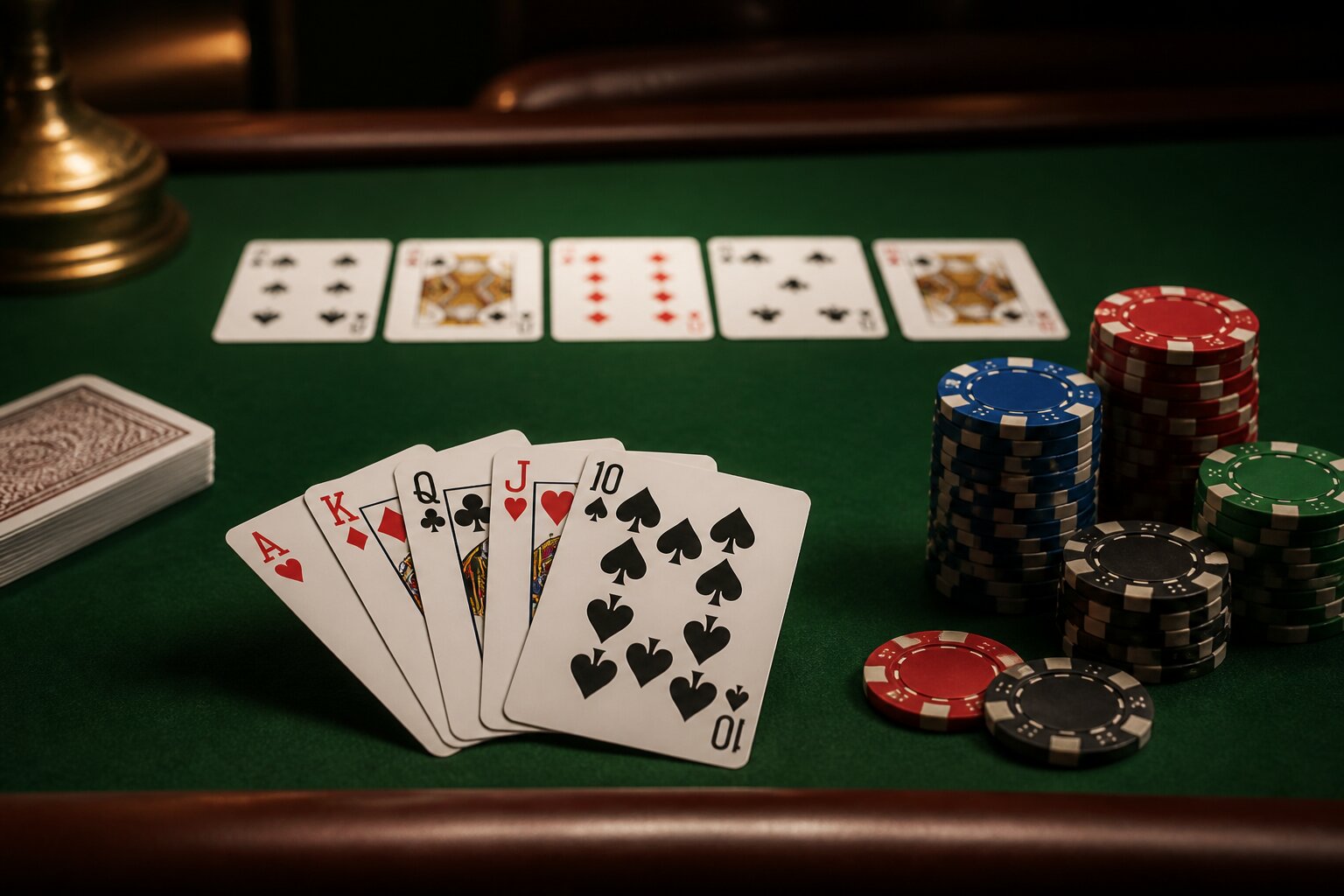
Ready to master the basics of poker? Whether you play casually or want to improve, knowing the hand rankings is essential. It tells you which combinations win and helps you read a showdown without hesitation.
Many players get mixed up by similar terms or rare combinations. This guide lays out each hand from highest to lowest and explains how ties are settled, so you can feel confident at the table.
Stick with it and you’ll have a clear reference that makes decisions straightforward and the game more enjoyable.
What Are Poker Hand Rankings?
Poker hand rankings are the standard order used to decide which five-card combination wins at the end of a round. They apply across most poker variants, so once you learn them you can use that knowledge in many different game types. The same basic hierarchy appears in games from Texas Hold'em to Seven Card Stud, although some variants have specific rules about how hands are formed.
Each poker hand is judged as a five-card combination. Even when more than five cards are dealt to a player, only the best five-card combination counts. The higher the rank of that combination, the stronger the hand, and that is what determines who wins when players reveal their cards at showdown.
These rankings also set the framework for how ties are settled and how hand strength is compared. For example, two players might both have a flush, but the player with the higher cards in the flush will win. Knowing the order lets you see at a glance which hands beat others and how kickers or card values decide close calls.
Understanding the order helps you follow play and make better assessments during a hand by allowing you to:
- evaluate your chances relative to the likely hands other players might hold
- avoid simple errors when comparing hands at the showdown
- recognise when your hand is strong enough to continue or when it is vulnerable and likely to lose
How Are Poker Hands Ordered From Strongest To Weakest?
The list below runs from the strongest hands down to the weakest. Read through them to understand why some combinations outrank others, and note the distinctions that matter when two players hold similar hands.
Royal Flush
A Royal Flush is the top straight of Ace, King, Queen, Jack and Ten, all in the same suit. It is the rarest and strongest hand because it is the highest possible five-card sequence in a single suit.
A Royal Flush cannot be beaten by any other hand. If two players somehow hold identical community cards producing the same royal flush, the result is a tie and the pot is split.
Straight Flush
A Straight Flush is any five consecutive cards in the same suit, such as 7, 8, 9, 10 and Jack of clubs. It is second only to a Royal Flush in strength.
When two straight flushes meet, the one with the higher top card wins. The Ace can be high or low in a straight flush only where the rules permit, for example A, 2, 3, 4 and 5 is a valid low straight flush.
Four of a Kind
Four of a Kind consists of four cards of the same rank plus any fifth card. For example, four Queens plus a 5.
If two players both have four of a kind, the higher set of four determines the winner. If those are equal because the four of a kind comes from community cards, the kicker card is compared to break the tie.
Full House
A Full House combines three cards of one rank and two of another, such as three 10s and two 6s. It ranks below Four of a Kind but above a Flush.
When comparing full houses, the three-of-a-kind part is compared first, then the pair. A full house with higher trips always beats one with lower trips, even if the pair is lower.
Flush
A Flush is five cards of the same suit that are not in sequence. For example, A, J, 9, 5 and 2 of hearts.
If two players have flushes, the highest card within each flush decides the winner. If those are equal, the next highest cards are compared in order until a difference appears.
Straight
A Straight is five consecutive cards in mixed suits, for example 4, 5, 6, 7 and 8 of various suits. It ranks below a Flush but above Three of a Kind.
Straights are compared by their top card. An Ace can count high or low depending on the sequence in play, so A, K, Q, J and 10 is the highest straight and A, 2, 3, 4 and 5 is the lowest.
Three of a Kind
Three of a Kind is three cards of the same rank plus two unrelated cards. For instance, three 7s with a King and a 3.
When matching three of a kind, the rank of the three cards determines the stronger hand. If those are equal, the highest of the two side cards are compared, then the next if needed.
Two Pair
Two Pair contains two different pairs plus a fifth card, such as two Kings, two 4s and a 9.
Hands with two pairs are compared first by the higher pair, then the lower pair, and finally by the kicker card if needed to break ties.
One Pair
One Pair is simply two cards of the same rank with three other distinct cards. For example, two Jacks with a 10, 6 and 3.
If two players have the same pair, the highest remaining cards are compared in descending order until a winner is found or the hands are identical.
High Card
High Card is used when no other hand is made. The single highest card determines the value, for example an Ace high hand beats a King high hand.
If the highest cards match, the next highest cards are compared in turn until a difference appears or the hands are found to be identical.
Before moving on, keep these distinctions in mind:
- Sequence refers to whether the cards form consecutive ranks.
- Suit uniformity means how many cards share the same suit.
- Number of identical ranks covers pairs, three of a kind and four of a kind.
These features define each hand and decide which one outranks another.
What Beats What In Poker?
The ranking order means a hand higher on the list will always beat any hand lower down. For example, a Full House defeats a Flush, and a Straight loses to a Flush because of their positions in the hierarchy.
When two players hold the same category of hand, the comparison relies on the card values that make up the combination. For instance, a pair of Queens beats a pair of Tens, and within straights or flushes the highest card in the five-card set determines the winner.
These rules apply whether you are in a casual home game or a more formal setting. They keep outcomes consistent and help everyone understand how a showdown will be resolved.
How Do Ties Work In Poker Hand Rankings?
Ties are resolved by comparing the specific card values that form each hand. The aim is to find a clear winner by looking only at the cards that make up the ranked hands and applying the established ranking rules.
For One Pair and Two Pair, the ranks of the pairs are checked first. If those are equal, the remaining cards are used as tie-breakers. In practice this means comparing the highest of the remaining cards, then the next highest, and so on until a difference is found. If all relevant cards are identical, the players split the pot.
With Straights and Flushes, the highest card in the five-card sequence or suit determines which hand is superior. If two players have straights or flushes that use the same top card and the same sequence, their hands are equal and the pot is shared between them.
This tie-breaking approach ensures fairness by relying only on the cards shown and the ranking rules already described. It removes ambiguity and provides a consistent method for resolving contests where hands appear similar.
Common Misconceptions About Poker Hands
There are a few persistent errors that trip players up. One is the belief that a Flush always beats a Full House; in reality a Full House ranks above a Flush. Another is thinking suits can be ranked against each other; standard poker treats all suits as equal.
A related confusion is the idea of three pairs. Since only five cards count, the best five-card combination is used, so three separate pairs are not possible in a final hand. It also helps to remember that an individual high card matters only when no stronger combination applies, or as a tie-breaker within the same hand type.
Clearing up these misunderstandings makes it easier to evaluate hands at showdowns and reduces mistakes when comparing results.
Why Is Understanding Poker Hand Rankings Important?
Knowing the hand hierarchy lets you interpret the action at the table and assess outcomes with confidence. It helps you understand why a particular hand wins or loses and removes much of the guesswork from play.
It makes it simpler to follow the flow of a game, compare your cards against visible possibilities, and avoid misreading opponents’ hands. In particular, it helps you:
- follow the sequence of play more easily,
- compare your holdings against common board combinations,
- spot when an opponent’s declared hand is impossible or unlikely.
This knowledge supports thoughtful decision-making and helps maintain a steady approach to play. When you can judge hands quickly and accurately, you are less likely to make simple mistakes and more likely to keep the game moving at a comfortable pace.
Understanding rankings also improves the social and competitive aspects of poker. You will find it easier to discuss hands, settle disputes at the table, and enjoy the game without confusion. Remember to play responsibly and within your limits at all times.
Frequently Asked Questions About Poker Hand Rankings
Below are answers to questions players commonly raise as they learn the rankings and apply them in play.
What is the highest poker hand I can get?
The highest hand is a Royal Flush, comprised of Ten, Jack, Queen, King and Ace of the same suit.
Can suits ever decide a winner in poker?
No. Standard poker rules do not rank suits against each other. If a specific game variant uses suit rules they should be stated clearly by the host.
What if two players have exactly the same hand?
When hands are exactly equal in value, the pot is split between those players. This is the standard way to resolve identical hands.
Is it possible to have more than five cards in a poker hand?
No. Official poker hands are always evaluated as the best possible five-card combination, even if players receive more cards during play.
Do I need to remember all the rankings before playing?
It helps to know the order, but many players use a short reference until they are comfortable. If the game stops being enjoyable or causes concern, it is sensible to pause and seek support.
For impartial advice and help with safer play, resources such as BeGambleAware.org are available.
**The information provided in this blog is intended for educational purposes and should not be construed as betting advice or a guarantee of success. Always gamble responsibly.