
Poker isn’t a single game but a family of related games that share certain core ideas while differing in important ways. You’ll see that small rule changes — how cards are dealt, how betting works, or which cards count — can give each variation its own tempo and challenges.
This guide walks through the main types of poker you’re likely to encounter, explains what makes each one distinct, and helps you decide which might suit your style. Read on and you’ll quickly spot the differences that matter.
What Defines a Poker Variation?
A poker variation is a set of rules that changes how a hand is played. The differences usually fall into three main areas: how cards are dealt, how betting is structured, and how a winning hand is formed.
Dealing can be private (face-down), public (face-up), or a mix of both. Some games use community cards that everyone can combine with their private cards; others leave each player to build a hand solely from their own cards. Betting structures vary too — fixed limits, pot limits or no-limit betting alter the risk and reward of each decision. Finally, each game uses the standard hand rankings, but the way those hands are formed can vary considerably and affect strategy.
Understanding these elements early on makes it easier to pick up a new variant, since they determine both the tactical depth and the social feel of the table.
How Do Poker Variations Differ by Rules and Gameplay?
Variations differ most noticeably in three practical ways: card distribution, rounds of betting, and permitted hand construction. These determine how complex a game feels and how much information players have during play.
In community-card games, such as the most common variant, players use a mix of private and shared cards. Draw games let a player change part of their hand, while stud games reveal some cards progressively, so visible cards influence decisions. The number of betting rounds also shapes the game’s rhythm: some formats are quick and immediate, others provide several opportunities to reassess.
Betting limits — fixed, pot-limit or no-limit — change how aggressively players can act and how big the swings can be. Together, these features create very different experiences even when the basic goal — make the best five-card hand — remains the same.
Which Poker Games Are Most Popular in UK Casinos?
Certain poker variations are widely available across UK venues and online sites, and they tend to define what most players expect from a poker room.
- Texas Hold’em is the standard for most cash games and tournaments, prized for its balance of accessibility and depth.
- Omaha offers a more complex hand-building process by giving players additional private cards to combine with the community cards.
- Three Card Poker and Caribbean Stud are common in casino environments where players prefer quick, dealer-versus-player formats.
These games are run under strict regulatory standards, and you’ll find them at a wide range of stakes and table formats. If you want to try something new, looking for these familiar names is a good place to start.
What Is Texas Hold'em and Why Is It So Widely Played?
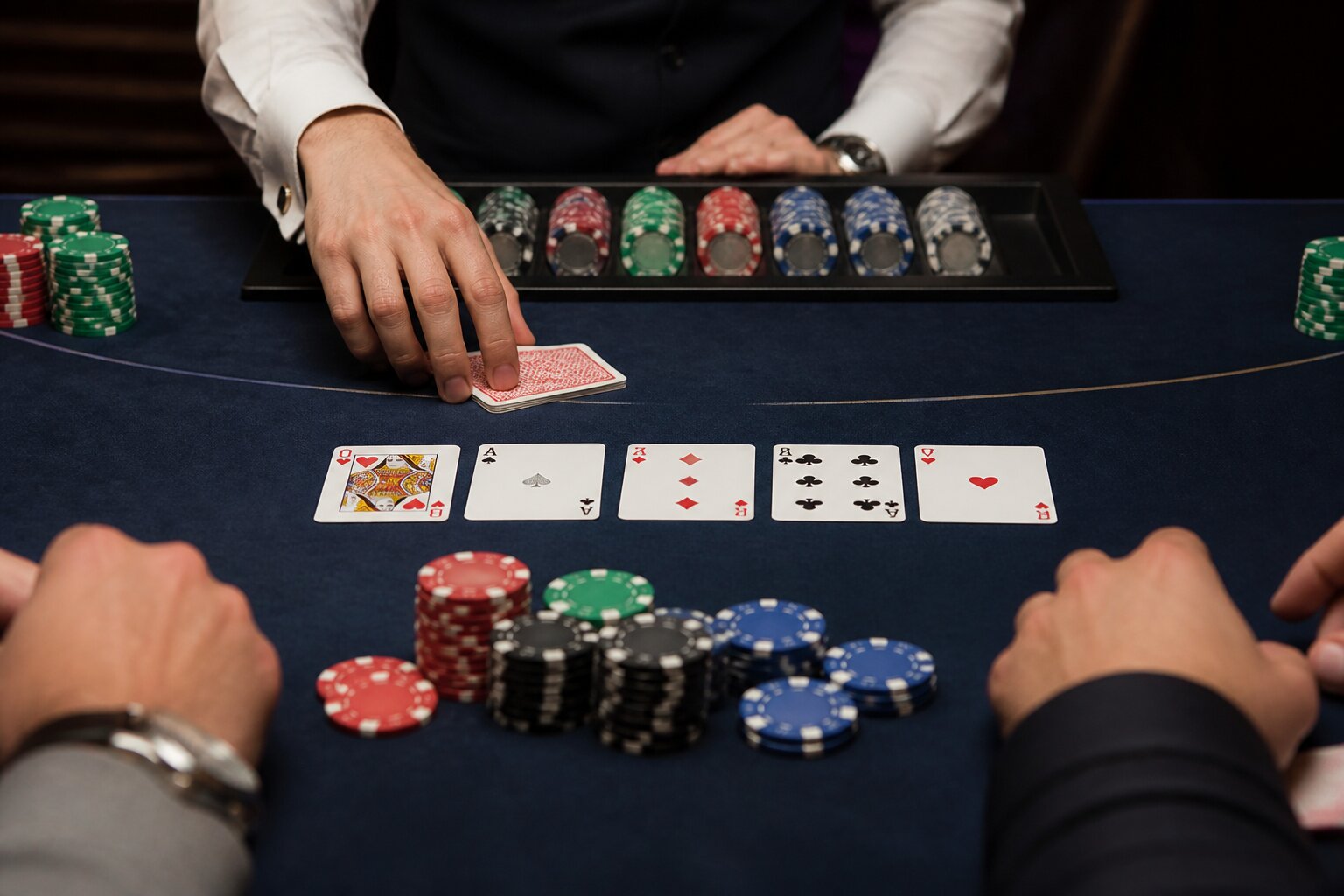
Texas Hold’em deals each player two private cards and places five community cards face-up in stages. Players aim to make the best five-card hand from any combination of their private cards and the community cards. Games are normally played with between two and ten players at a table, and betting is driven by forced bets called blinds that rotate around the table.
The game moves through several betting rounds, which creates strategic depth without overwhelming new players. Each round gives players information they can use to adjust their choices, but some uncertainty always remains because opponents’ private cards are hidden. That balance of revealed and concealed information produces tense decision points and room for skill to matter over time.
The combination of open information from the community cards and hidden private cards makes for tense decision points and opportunity for skillful play. Because outcomes depend on both chance and judgement, Hold’em rewards long-term thinking: good decisions reduce risk and increase expected value, but they do not guarantee short-term wins. That blend of clarity and complexity is why Hold’em is the most common tournament and cash-game format, appealing to both beginners learning the basics and experienced players exploring deeper strategy.
What Makes Omaha Poker Distinctive?
Omaha shares the community-card layout with Hold’em but gives each player four private cards instead of two. That extra pair of hole cards changes how you view hand strength from the outset, because combinations that are unlikely in Hold’em become much more common in Omaha.
Importantly, players must use exactly two of their private cards and three community cards to make their final five-card hand. This rule produces several distinct effects on how hands develop and are played:
- different sets of hands become likely compared with Hold’em, with more frequent strong made hands and multi-way winners
- often larger showdowns, because more combinations can develop that clash or tie
- a greater emphasis on how hole cards work together, not just on individual card strength
Omaha tends to be action-heavy and rewards careful consideration of how private cards will interact with the community cards. Players need to think about multiple-card combinations, coordinated suits for flush possibilities, and connected ranks for straight draws. Double-suited hands and coordinated connectors are particularly valuable because they create more simultaneous draw opportunities.
It’s popular with players who enjoy richer hand possibilities and more dynamic board textures. Games often feature bigger pots and more complex decisions, so good hand-reading and pot-control instincts are helpful.
How Does Five-Card Draw Work?
Five-Card Draw gives each player five private cards and uses no community cards. Play usually begins with a deal of five cards to each player, followed by an initial round of betting. After that, players have a single chance to exchange unwanted cards for new ones from the deck.
The draw phase is where each player chooses how many cards to discard and replace. Table rules vary, but commonly players may draw up to three cards, with a fourth permitted in some games when swapping an ace. Once the dealer has dealt replacement cards, a final betting round takes place.
The game typically proceeds through these phases:
- Dealing five cards to each player
- Initial betting round
- Single draw phase where players exchange cards
- Final betting round
- Showdown, where remaining players reveal hands and the best hand wins
Its straightforward structure makes Five-Card Draw easy to learn, and the single draw phase creates a compact, focused contest of hand evaluation and reading opponents. The limited number of betting and draw opportunities sharpens decisions about risk and hand strength in each hand.
Many home games favour this format for its simplicity. Some card rooms and clubs include Five-Card Draw occasionally for variety, and local rules or small variations are common, so it is sensible to check house rules before playing.
What Should You Know About Stud Poker?
Stud poker deals a mix of face-down and face-up cards to each player, with no shared community cards. Players build their best hand from only the cards they receive. Betting occurs after new cards are revealed, so each round of play changes the information available to everyone at the table.
The visible information, the up-cards, becomes an important part of strategy. By watching those cards you can judge likely holdings, estimate opponents' ranges and adapt your betting. Memory and attention to detail are useful skills, because the cards that have been shown influence both odds and how other players are likely to act.
Two commonly played variants are:
Seven-Card Stud Overview
Seven-Card Stud delivers seven cards to each player over multiple rounds, with three dealt face-down and four face-up. There are several betting rounds as the hand progresses, which gives more opportunity for skillful reading, bluffing and pot control. Players select their best five-card combination at showdown, so the extra cards give greater scope for strong hands but also require careful judgement.
Because up-cards are revealed repeatedly, positional awareness and memory become even more valuable. Tracking which cards are visible can help you work out what combinations remain possible and how opponents are likely to respond.
Five-Card Stud Essentials
Five-Card Stud is a faster, more compact game where each player receives one card face-down and four face-up. With fewer cards dealt and quicker rounds, decisions must be made more rapidly and visible cards often drive betting choices.
The shorter format tends to reward straightforward, disciplined play and sharper observation of opponents. Because there is less hidden information, aggression and timely folding both become important tools.
Play responsibly and be aware of the stakes before you join a game.
Are There Unique British Poker Variations?
There are British-style games and regional favourites that add local character to poker sessions, often emerging in pubs or private games. These variants tend to be more social and informal than casino offerings, with a stronger emphasis on bluffing, banter and quick rounds.
One traditional example is Three Card Brag, a short game based around three-card hands and bluffing. While different from standard poker, it shares the same competitive spirit and is still played socially, especially at friendly gatherings and club nights.
In commercial casino settings the focus is on internationally recognised variations, but regional games show how players adapt rules to suit local tastes. If you encounter a home rule or local variant, it is sensible to clarify exact rules before joining a hand. In particular, check:
- the stakes and betting structure, including antes or blinds
- how the dealer/button is determined and passed
- any special hand rankings or wild cards
- the number and order of betting rounds and any show-down procedures
Agreeing these points beforehand avoids disputes and keeps play friendly and fair.
How Does Online Poker Expand Game Choices?
Online platforms broaden the pool of available variations and formats. Sites run many tables around the clock, offering different stake levels, blind structures and both cash games and tournaments. Online play also makes it easy to sample less common types of poker or to join fast-fold formats that are impractical in physical rooms.
Most sites provide rules pages and practice modes so you can learn without financial pressure. Digital play can speed up learning by letting you see many more hands in a short time, but it also changes the social cues you rely on in live play, so adapt your approach accordingly.
Is Poker a Game of Skill or Chance?
Poker combines careful decision-making with the inherent randomness of which cards are dealt. Over many sessions, players who apply sound strategy and discipline generally achieve better results than those who play without structure. However, individual hands and short-term runs can still be heavily influenced by chance.
Key skill areas include:
- hand selection and knowing which hands to play
- bet sizing to manage the pot and pressure opponents
- position and how seat order affects choices
- reading opponents and adapting to their tendencies
Regulated venues and reputable online operators follow rules, licensing conditions and independent oversight to promote fair play. That consistency helps ensure skillful approaches have an impact across multiple sessions, even though single hands may produce surprising outcomes. Play responsibly and be aware that variance means short-term results do not always reflect long-term ability.
What Are Common Misconceptions About Poker Variations?
One common misconception is that some variations make winning much easier. In reality, every variant has its own balance of skill, strategy and unpredictability. Some games may reduce variance in the short term, but long-term success still depends on sound decision making and good bankroll management.
Another mistaken belief is that poker games are only for experts. Many formats are accessible to beginners, with clear rules and slow-learning variants ideal for newcomers. There are plenty of learning resources, including tutorials, strategy articles and community forums, that can help new players build confidence and improve over time.
Finally, some people think online play is inherently unsafe. While risks exist, choosing a regulated operator and using the player-protection tools they provide helps to mitigate concerns. Responsible play also involves setting limits and using voluntary exclusion or self-assessment features when needed.
If you are unsure which game suits you, consider these sensible steps:
- Try tutorials and free-play modes to learn the rules without financial risk.
- Start at low-stake tables to gain experience with real opponents while limiting losses.
- Use bankroll and session limits to protect yourself and play within your means.
These approaches help you find a game that matches your comfort level while encouraging safer, more enjoyable play.
How Can You Choose the Best Poker Game for You?
Choosing a variant comes down to what you enjoy and how you like to play. If you prefer a format that mixes open information with private decision-making, community-card games such as Texas Hold’em are a solid choice. If you favour larger hand possibilities and more complex combinations, Omaha might suit you. If you like quick, straightforward play, draw and short stud games are worth trying.
Try different styles at low stakes or in practice environments until one clicks. Pay attention to table atmosphere, pace and how much strategic depth you want. Above all, pick games that you understand and enjoy — that combination will keep play satisfying.
This guide should help you recognise the key differences between popular poker variations and steer you to games you’ll enjoy. Whatever you choose, play within your means and focus on improving your strategy and experience at the table.
**The information provided in this blog is intended for educational purposes and should not be construed as betting advice or a guarantee of success. Always gamble responsibly.