
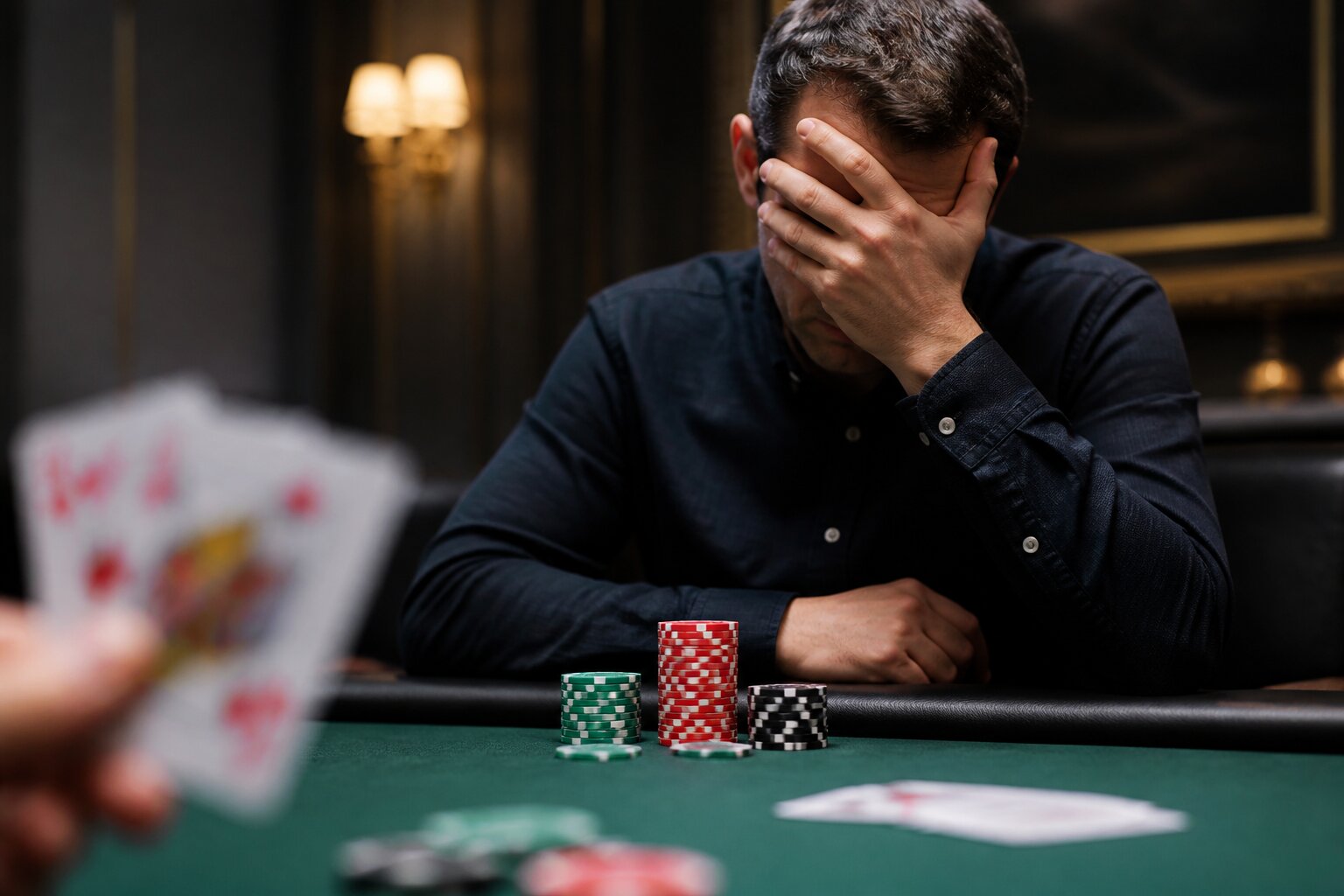
Every poker player has a story about that one unforgettable hand where everything seemed to go right—until it didn’t. If you’ve ever lost with a brilliant hand, you’ve likely experienced a “bad beat”.
Curious about what a bad beat actually means, why it happens, and what other key poker terms you should know? You’re in the right place.
Keep reading to uncover the ins and outs of bad beats, learn from real-life examples, and brush up on essential poker lingo. Whether you’re new to the game or returning after a break, this guide will help demystify those gut‑wrenching moments and sharpen your understanding of how poker outcomes unfold.
What Does 'Bad Beat' Mean in Poker?
A ‘bad beat’ describes a situation where a player holding a very strong hand loses to an opponent whose hand looked much weaker earlier in the round. This change in outcome usually occurs because the shared community cards produce a combination that favours the opponent at a late stage of the hand.
Bad beats are a consequence of probability and variance in the deck. Even when decisions are well judged and play is sound, the cards that appear on the board can produce surprising shifts in which hand is the best. The key point is that a bad beat describes an unexpected reversal in a single hand’s outcome rather than any long‑term failing in skill.
Feeling frustrated after a bad beat is normal; it’s part of the emotional landscape of poker. Learning to accept these moments helps maintain clearer thinking in the hands that follow, and we’ll look next at how often they typically occur.
How Common Are Bad Beats in Poker?
Bad beats occur with regularity, but their frequency varies with the game format and the number of players. Tables with more players or more aggressive betting tend to produce more large pots, and therefore more opportunities for unlikely card combinations to decide a hand.
Another factor is volume: in online play you generally see many more hands per hour than at a live table, so rare events naturally crop up more often in a single session. That perceived increase isn’t because online games are somehow different in fairness; it’s a matter of exposure to more hands in the same period.
Understanding how often bad beats might happen helps set realistic expectations and encourages players to evaluate their own decisions over a longer run rather than judging them by any single hand. Up next are some famous real‑world examples that show how dramatic these moments can be.
Famous Bad Beats: Notable Real-Life Examples
Some of poker’s most talked‑about hands are famous precisely because they fit the definition of a bad beat: a strong favourite loses when the board changes everything late in the hand. High‑profile tournaments have produced dramatic moments that stick in players’ and fans’ memories.
One memorable example occurred in a major event in the mid‑2000s when a player holding pocket aces was beaten on the river by an opponent who completed a straight. Another notable hand from the 2010s featured pocket aces falling to a rivered jack, ending a player’s deep run in the tournament. These hands are often replayed because they show how a single card can alter the outcome and the stakes involved when big pots are on the line.
Such hands underline the emotional stakes at top‑level play and how important it is to manage reactions when the unexpected happens. The next section looks at the psychological and practical effects these moments have on players.
How Do Bad Beats Affect Poker Players?
Bad beats can trigger strong emotional responses: frustration, disbelief, and sometimes anger. For many players, a single severe loss will shape the mood for the rest of a session unless it is recognised and managed. That emotional carryover can influence subsequent decisions, often in ways that reduce long‑term results.
Players who react by changing their style dramatically or by taking unnecessary risks after a bad beat commonly see worse outcomes. Better results come from maintaining a steady approach, sticking to one’s strategy, and viewing individual hands as part of a much larger sample of play.
Beyond personal discipline, some players use structured tools—like pre‑set bankroll limits and session boundaries—to prevent a single hand from dictating behaviour. These practical steps help preserve both game quality and financial control. With these effects in mind, it helps to contrast bad beats with other poker terms so the distinction is clear.
How Are Bad Beats Different from Other Poker Terms?
A bad beat is specifically about a strong hand losing due to late changes on the board. That contrasts with a ‘cooler,’ where both players have very strong hands and the outcome is determined by who simply has the slightly better holding; coolers are about relative hand strength rather than a dramatic reversal.
Other terms capture different dynamics: a ‘bluff’ is an attempt to make opponents fold superior hands by betting or raising without the best cards, while a ‘slow roll’ is poor etiquette—taking too long to reveal a winning hand. Each term describes a distinct feature of poker play, whether it’s strategy, probability, or table manners.
Recognising these differences helps when analysing hands and discussing them with other players. Next, let’s look at common misunderstandings surrounding bad beats so you can separate fact from myth.
Common Misconceptions About Bad Beats
One misconception is that bad beats strike particular players more often; in reality, they can happen to anyone, because deck outcomes are impartial. Another myth is that online play produces more bad beats due to questionable dealing; this perception usually comes from the higher hand rate online, not from any difference in randomness.
Some players think a bad beat signals a need to immediately change style or escalate risk to recover losses. In practice, reacting impulsively often worsens results. A measured review of the hand and a focus on long‑term decision quality are more productive responses.
Clearing up these misconceptions keeps analysis grounded and helps players respond constructively after a tough hand. That foundation makes it easier to understand the mechanics of one particular mitigation some casinos and rooms offer: the bad beat jackpot.
What Is a Bad Beat Jackpot?
A bad beat jackpot is a supplementary prize paid when an extraordinary losing hand meets set criteria. It’s intended to compensate a player who was beaten despite holding an exceptionally strong hand, and the funds are typically built from small contributions taken from qualifying pots at the table.
Because the jackpot requires specific conditions—such as a minimum hand strength and both players using both hole cards—the payouts are rare but meaningful when they occur. The structure and qualification rules vary between venues, and the distribution usually splits the jackpot among the loser, the winner, and other players who were dealt into the hand.
Below is a short explanation of how these jackpots are commonly triggered and where you might encounter them.
How Does a Bad Beat Jackpot Work?
To trigger a jackpot, games set precise conditions: the losing hand must meet a stated minimum (often four‑of‑a‑kind or better), and both the winning and losing players normally need to show both hole cards. Once triggered, the jackpot is allotted according to the venue’s rules, with the largest share often going to the unlucky loser and smaller portions shared among the table.
The payout mechanics and qualifying thresholds differ by location, so it’s worth checking the posted rules where you play. Now that you understand the jackpot concept, the next section explains where these prizes are typically offered.
Where Can You Find Bad Beat Jackpots?
Bad beat jackpots are most commonly seen in larger cardrooms and some online rooms that choose to run them. They’re usually advertised at tables where they apply and come with clear qualifying rules. Because they depend on rare hand outcomes, they’re not a substitute for sound bankroll management and should not be a reason to change playing behaviour.
Having covered jackpots, the remaining questions players often ask deal with inevitability, online versus live differences, and how best to respond after a tough hand.
Can bad beats be avoided?
No. Bad beats cannot be avoided because they arise from the random order of the deck and the way cards are revealed during a hand. Skill influences many decisions and long‑term expectations, but variance means every player will encounter bad beats at some point.
Accepting that they are a natural feature of the game helps players focus on the aspects they can control: decision quality, bankroll discipline, and emotional responses. With those controls in place, bad beats become merely difficult moments rather than determinative events.
Do online poker games have more bad beats than live games?
There is no inherent difference in the likelihood of bad beats between online and live poker when rules and dealing are fair. The impression that online sites produce more bad beats comes from the higher volume of hands dealt per hour online; more hands mean more chances for rare outcomes to appear in a session.
Other factors, like game speed and table size, can influence perception, but not the underlying probabilities.
What should I do after experiencing a bad beat?
After a bad beat, it is helpful to pause briefly, take stock, and refocus on long‑term decision making. Immediate emotional reactions often lead to poorer choices, so returning to your usual approach and sticking to planned limits is the most effective path forward.
Practical steps include reviewing the hand calmly to see if any adjustment is genuinely needed and taking a short break if emotions feel elevated. These measures support clearer thinking for the next hands you play.
Is chasing losses after a bad beat a good idea?
Chasing losses rarely improves outcomes. It tends to produce riskier decisions driven by emotion rather than strategy. Maintaining predetermined session and bankroll limits prevents a single hand from causing disproportionate financial harm.
Keeping a consistent approach to stakes and time spent at the table protects both your results and enjoyment of the game.
Where can I get help with problem gambling?
If gambling is causing concern, support organisations provide confidential advice and tools to help manage play. Many cardrooms also offer features such as deposit limits and time‑outs to assist players in staying within their planned boundaries.
If you feel you need support, consider reaching out to a recognised helpline in your area for guidance on available options.
This overview explains what a bad beat is, why it happens, how it can affect players, and the ways venues sometimes compensate for them. Understanding these points helps keep perspective when difficult hands occur and supports better decisions in future play.
**The information provided in this blog is intended for educational purposes and should not be construed as betting advice or a guarantee of success. Always gamble responsibly.