
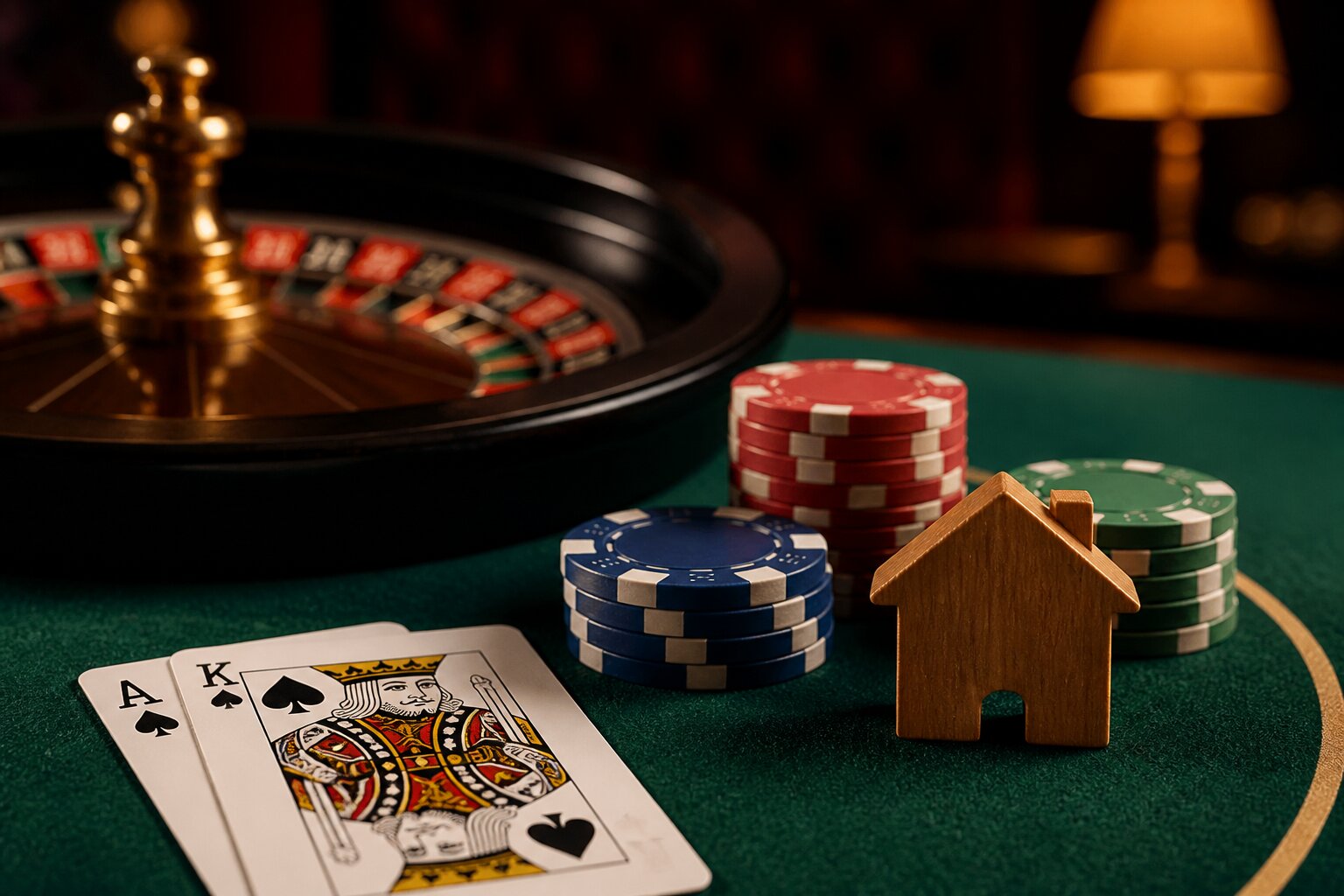
Ever wondered why the casino often ends up ahead, even when some players have big wins? There’s a clear reason, and it all comes down to the “house edge”.
Whether you’re spinning the reels of an online slot or joining a live table, the house edge is the mathematical advantage that operates quietly in the background. Understanding it helps you make clearer choices about the games you play and how long you play them.
If you want to know what the house edge means, how it works, and why it matters each time you place a bet, this guide will explain it in plain English.
What Does House Edge Mean in Online Casinos?
House edge is the built-in advantage that casinos have over players in every game. In online casinos this works the same as in brick-and-mortar venues.
The house edge is expressed as a percentage and shows how much, on average, the casino expects to keep from each stake you place over time. For instance, a game with a 5% house edge implies the casino will retain, on average, £5 for every £100 wagered across many bets.
That percentage is a long-run average. Individual sessions can produce very different results because outcomes vary each round. Understanding the house edge lets you see which games give better value and which ones are likelier to erode your balance faster if you play extensively.
Why Is the House Edge Important for Players?
Knowing the house edge helps you choose games more wisely. It reveals the likely cost of playing a particular game over an extended period and lets you compare options objectively.
A lower house edge generally means you will retain more of your stakes on average, so your budget lasts longer. Conversely, a higher house edge means your stake will be reduced more quickly over time. This information is useful when planning how much to spend and how long to play.
Being aware of the house edge also highlights that all casino games are structured to favour the operator in the long term. That does not rule out short-term wins, but it does mean planning and sensible limits are important to keep play enjoyable and affordable.
How Is House Edge Calculated?
The house edge is derived from the difference between the true mathematical odds of an outcome and the payouts offered by the operator. That gap is what produces the casino’s long-term advantage.
Take roulette as an example. A single-number bet pays 35 to 1, but on a European wheel with 37 pockets the true odds are 36 to 1. Over many spins this discrepancy results in a small but consistent advantage for the casino. If you bet £1 on every number across 37 spins you would stake £37 and, on average, receive £36 back from the winning number, producing an average loss of £1. That translates to a house edge of roughly 2.7%.
These calculations rely on very large numbers of rounds. They express expected outcome over time rather than predict any single spin or hand. Short sessions will often deviate considerably from these averages because outcomes vary from round to round.
Do Different Casino Games Have Different House Edges?
Yes. Each online casino game has its own house edge because of different rules, payout structures and winning conditions.
Blackjack can offer a low house edge, sometimes below 1% when played with optimal basic strategy and favourable rules. European roulette typically sits at about 2.7% while American roulette rises to around 5.26% because of the extra pocket. Online slots vary widely; some have house edges near 2% and others exceed 10% depending on the paytable and volatility.
These differences come from the underlying mathematics of each game. Some games allow player decisions that alter expected returns, while others are entirely based on random outcomes that players cannot influence.
Is a Lower House Edge Always Better?
A lower house edge generally means better value in the long term because less of your stake is expected to be retained by the casino. That makes games with smaller edges preferable if your aim is to stretch a budget and reduce the expected rate at which your funds decline.
However, a lower house edge does not guarantee a better outcome in any particular session. Short-term variation can be substantial, and results in a single visit may be very different from the long-run average. Several factors explain why that can happen:
- Natural variance and randomness mean outcomes can swing widely in the short term, regardless of the edge.
- Bet size and staking patterns affect how variance shows up during a session.
- Specific game features, such as bonus rounds or jackpots, can produce rare large wins that skew results.
Choose games you enjoy and structure your play around limits that suit your spending plan rather than expecting a specific outcome. Set a clear budget, decide on time and loss limits, and treat gambling as entertainment rather than a way to make money. If you are ever concerned about your play, seek help from a recognised support service.
Common Myths About House Edge
A few misunderstandings about house edge circulate frequently, so it helps to be clear.
One myth is that games become “hot” or “cold” and therefore more or less likely to pay out based on prior results. In properly operated online games, each round is independent and previous outcomes do not change the odds of the next one. Another misconception is that betting systems or strategies can overcome the house edge. While some approaches can help manage your money or improve decision-making in skill-based games, they cannot alter the built-in mathematical advantage inherent to the game.
Keeping these points in mind helps you separate useful tactics from unsupported claims.
Where Can You Find the House Edge for Online Games?
Game information pages and help sections usually display RTP, which stands for Return to Player. RTP is the percentage that an operator returns to players over time and is the inverse of the house edge. For example, a slot with a 96% RTP corresponds to a 4% house edge.
Many operators publish RTP and house edge figures in the game rules or on provider pages. Checking these figures before playing gives you clear expectations about how a game will behave over the long run and helps you compare games on a like-for-like basis.
On this site we aim to display RTP and house edge details where possible so you can make informed choices before you play.
How Does House Edge Affect Winnings Over Time?
The house edge determines the operator’s expected share of wagers over a long sequence of rounds. With a 5% house edge, you would expect to lose roughly £5 for every £100 wagered if you were to play many, many rounds of the same game.
In shorter sessions the result may be quite different because outcomes fluctuate from round to round. That short-term variability is why occasional large wins and losses occur even when the house edge remains unchanged. Knowing how house edge works makes it easier to interpret these swings and to set realistic expectations about how long your budget will last.
Plan your play around how much you are willing to risk over time, and consider house edge when comparing the potential value of different games.
Final Thoughts on Understanding House Edge
Understanding the house edge gives you a clearer picture of how online casino games operate over time. It is not a promise about any single session, but a reliable measure of the long-term relationship between stakes and returns.
Use house edge and RTP figures as tools to choose games that match your preferences and budget. Keep play entertaining by setting sensible limits and stepping away when those limits are reached.
If you or someone you know needs help with gambling, confidential support is available from services such as BeGambleAware and GamCare. We present house edge and RTP details openly so you can make informed choices, and we encourage thoughtful, controlled play.
**The information provided in this blog is intended for educational purposes and should not be construed as betting advice or a guarantee of success. Always gamble responsibly.