
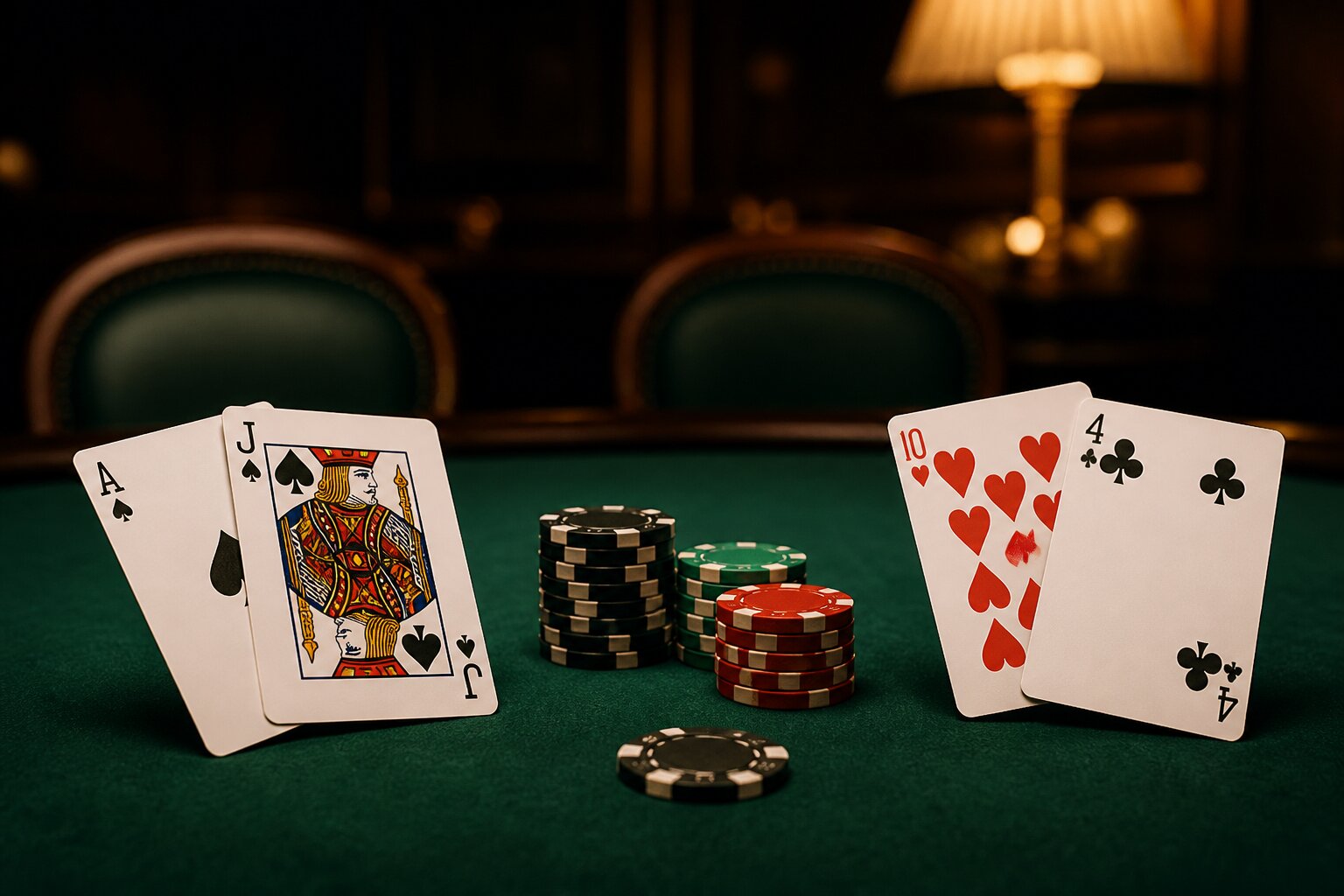
Think you know the best and worst blackjack hands? You might be surprised. Many players fall into the same traps, trusting myths and misconceptions that can affect how they play.
Before you sit down at the table, it helps to separate fact from folklore. This guide explains which hands matter, why they matter, and how common misunderstandings change the choices you face.
Understanding Blackjack Hand Rankings
Understanding blackjack hand rankings is simpler than many expect. Unlike poker, where combinations form a hierarchy, blackjack focuses on the numerical total of your cards relative to 21.
Number cards count at face value. Face cards are worth 10 points each. Aces can count as 1 or 11, whichever gives the best total without exceeding 21. A two-card ace plus a 10-point card is a natural blackjack, the strongest opening hand because it reaches 21 immediately.
Other totals matter only in how close they come to 21 without going over. There are no suit values or special combinations beyond totals, so the whole game reduces to managing that total and reacting to what the dealer shows.
Here are some plain examples of how totals form:
10 + 7 = 17
9 + 8 = 17
King + 6 = 16
Ace + 7 = 8 or 18
Queen + 5 + 3 = 18
7 + 7 + 7 = 21
With the scoring clear, the next question is which specific hands give the best chances at the table and why. That leads us to the strongest positions a player can hold.
What Are the Best Blackjack Hands?
The best hands are those that put you in the strongest statistical position against the dealer without going over 21. A natural blackjack is top of the list: an ace plus any 10-value card as your first two cards. It typically pays better than a regular win and is the most favourable starting point you can get.
Closely behind that are high totals like hard 20 and soft 20. A hard 20 (for example, two 10s) is a powerful holding because it is difficult for the dealer to beat. A soft 20—an ace and a nine—adds the flexibility of the ace, so the hand can absorb a hit without the same risk of busting.
These hands do not guarantee a win, but they place the player in a strong position. If you want to understand how standing or taking extra cards interacts with dealer behaviour, the next section looks at the hands that create the tightest decisions and why they feel so uncomfortable to play.
What Are the Worst Blackjack Hands?
Some totals present the greatest dilemmas because they sit close to 21 but leave little room for improvement. Hard 16 and hard 15 are widely considered the toughest hands. They are just below the safer zone and often force a choice between standing and hoping the dealer busts, or hitting and risking an immediate bust.
A hard 16—combinations like 10+6, 9+7, or 8+8—is particularly vulnerable when the dealer shows a strong upcard. Winning percentages from these hands can be low, and the decision you make often depends on the dealer’s visible card.
Totals of 12 to 14 are middling hands that can quickly become problematic against a dealer’s high card, while very low totals give room to draw but require time to develop into a competitive total.
Weak hands do not mean a lost round; they mean the decisions that follow are more consequential. To see how some of these difficult hands are treated differently by basic strategy, we turn next to specific cases that commonly confuse players.
Soft 17 (Ace + 6 or Ace + 3 + 3)
A soft 17 contains an ace counted as 11 plus other cards adding to six. Because the ace can revert to 1, a soft 17 gives flexibility that a hard 17 does not. Basic strategy often recommends taking another card on soft 17 since the risk of busting is low and the chance to improve your total is significant.
Players sometimes stand on soft 17 out of a sense of caution, but the mathematical edge generally favours hitting in this situation. Understanding the reasoning behind that suggestion helps explain why other soft hands are treated differently at the table.
Pair of Eights (8 + 8)
Two eights result in a hard 16, which is a difficult single hand to win with. Splitting the eights converts one poor hand into two chances to improve, and basic strategy supports splitting in nearly every standard situation. The idea is to trade a likely losing single hand for the possibility of two winnable hands.
Some players hesitate because splitting requires an extra wager, but over many rounds splitting eights tends to yield better expected outcomes than keeping them together.
Pair of Aces (Ace + Ace)
A pair of aces is extremely valuable to split. Left together, they form a weak total that is hard to improve. Splitting gives each ace a chance to pair with a 10-value card and form strong hands, and basic strategy treats this as one of the clearest split decisions in blackjack.
These particular hands are confusing because they push against instinct. The tactical choices they force explain why understanding basic strategy reduces loss and keeps decisions clearer under pressure.
Myths & Misconceptions About Blackjack Hand Rankings
Misconceptions about hand strength can lead players into suboptimal choices. Clearing up a few common myths helps keep decisions grounded in how the game actually works rather than what feels right.
Is 21 always unbeatable? Not always. If the dealer reaches the same total, the round can be a push, which returns the stake without a win. A player who reaches 21 with multiple cards can still lose to a dealer natural blackjack. So 21 is the highest total but not an absolute guarantee of victory.
Do pairs always mean strength? No. Some pairs are weak by total. Two fives make 10, which is a reasonable starting point but not inherently powerful. Knowing which pairs to split and which to play as a unit is the practical skill that matters.
Are face cards the key to winning? Face cards help reach strong totals because they are worth 10 points each, but simply collecting face cards does not ensure success. What matters is how those cards form totals relative to 21 and the dealer’s likely outcome.
A clear view of these myths keeps expectations realistic and decisions consistent. Next, we examine how the dealer’s visible card shapes the choices you make from these positions.
The Importance of Dealer Upcards
The dealer’s upcard is one of the most important pieces of information at the table. It gives an indication of how the dealer’s final hand might land and therefore influences whether standing or taking more risk is the statistically sound option.
Dealer upcards of 2 through 6 are often called weak because the dealer has a higher chance of busting. When the dealer shows these cards, standing on lower totals can be a practical approach; the dealer may be the one to break 21 rather than the player.
Upcards of 7 through ace are stronger and usually compel more aggressive play from the player. When the dealer starts with a 7 or higher, the likelihood of the dealer reaching a competitive total increases, which can justify hitting or doubling down on hands that might otherwise be safe.
Understanding how dealer behaviour shifts with different upcards helps explain why strategy tables often change recommended plays between the same player totals. With that in mind, we next consider how players’ perceptions and experience shape their choices at the table.
How Blackjack Hand Perceptions Differ Among Players
Players bring varied perspectives to the table that influence how they treat particular hands. Experience, prior outcomes, and personal rules of thumb can make one player conservative with a pair of tens while another sees the same situation as an opportunity.
Soft hands, such as an ace and a six, are sometimes undervalued because their visible total can look low. Yet those hands carry flexibility that can be used advantageously. Conversely, high-looking totals built from face cards can feel secure even when the dealer might still overtake them.
These differences in perception matter because they affect risk tolerance and consistency of play. A sound understanding of the actual odds and the logic behind basic strategy keeps choices aligned with likely outcomes rather than gut feeling.
Whether you are new to the game or returning after a break, keeping decisions guided by clear principles rather than habit helps maintain more predictable results. Take these insights with you to the table and let them inform each hand you play — that will give you a clearer sense of when to hold firm and when to press for improvement.
Try Casino Entertainment at Late Casino
We’d love to welcome you to our site, where you can enjoy a comfortable and entertaining casino experience whenever you choose. Our friendly team is always here to make sure you feel right at home.
Getting started couldn’t be easier – create your account, make a deposit, and you’re ready to play. We’re looking forward to seeing you enjoy what we have to offer.
**The information provided in this blog is intended for educational purposes and should not be construed as betting advice or a guarantee of success. Always gamble responsibly.